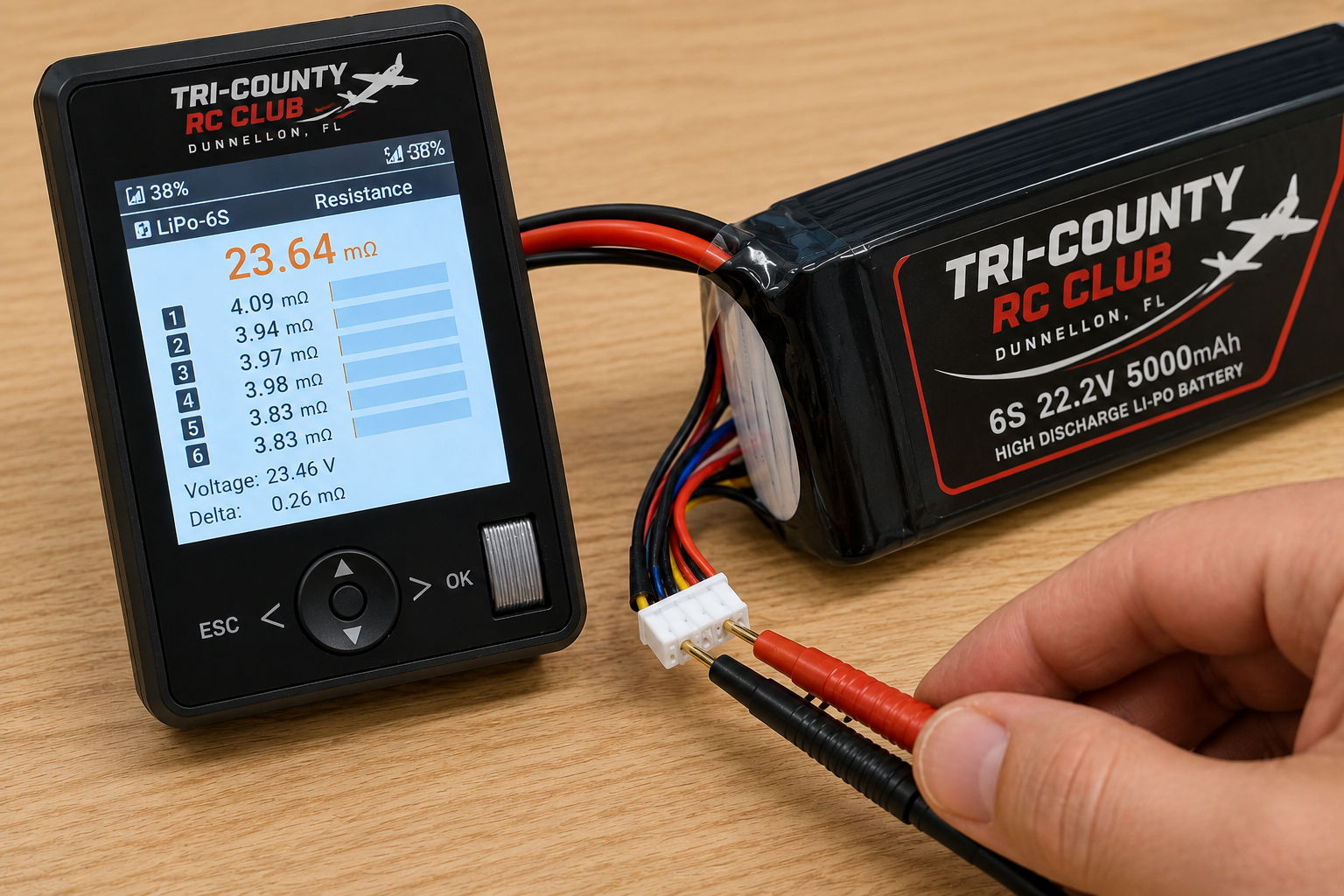
LiPo battery cell resistance is an important measurement that can help RC pilots understand the condition, performance, and remaining useful life of a battery.
LiPo stands for lithium polymer. Each cell inside a LiPo battery has a small amount of electrical resistance. This is commonly called internal resistance, or IR.
Internal resistance is the natural opposition to electrical current flowing through a single LiPo cell. It is created by the physical and electrochemical properties of the battery’s internal components, including:
- The electrodes
- The electrolyte
- The separator
- Internal tabs, wiring, and connections
Internal resistance is normally measured in milliohms, shown as mΩ.
One milliohm equals:
1 mΩ = 0.001 ohms
Although this resistance is very small, it can have a noticeable effect when a battery is delivering the high current required by an RC airplane, helicopter, drone, car, boat, or other high-power device.
What Happens When Internal Resistance Increases?
As electrical current passes through the battery, internal resistance causes some of the battery’s energy to be converted into heat.
Higher internal resistance can result in:
- Increased battery temperature
- Reduced efficiency
- Shorter flight or operating time
- Lower available power
- Greater voltage sag under load
- More stress on the battery
- A shorter overall battery lifespan
Voltage sag is the temporary drop in battery voltage that occurs when the motor, electronic speed controller, servos, or other equipment places the battery under a heavy load.
A battery may appear fully charged while resting, but its voltage can drop significantly when the motor is running. A battery with high internal resistance will normally experience more voltage sag than a healthy battery with low internal resistance.
Types of Internal Resistance in LiPo Cells
Internal resistance in a LiPo battery generally consists of two main components.
Ohmic Resistance
Ohmic resistance is the static resistance created by the battery’s materials, internal connections, tabs, wiring, and other conductive components.
This type of resistance follows Ohm’s Law:
V = I × R
Where:
- V is voltage
- I is current
- R is resistance
Ohmic resistance is the primary value measured and displayed by most modern battery chargers.
Polarization Resistance
Polarization resistance is a dynamic form of resistance associated with the electrochemical reactions taking place inside the battery.
It can increase as current demand rises, especially when the battery is placed under a heavy load. Higher current density causes more stress at the electrodes and can temporarily increase the battery’s effective resistance.
Together, ohmic resistance and polarization resistance limit how quickly a LiPo cell can deliver electrical current.
This is especially important in applications that require sudden bursts of power, including:
- RC aircraft
- RC helicopters
- Multirotor drones
- RC cars and trucks
- RC boats
- Power tools
- Other high-current electronic equipment
A battery with low internal resistance can generally deliver power more efficiently and with less heat than a battery with high internal resistance.
Typical Internal Resistance Values for LiPo Cells
There is no single internal resistance value that is correct for every LiPo battery.
Internal resistance varies depending on several factors, including:
- Battery capacity in milliamp-hours, or mAh
- Discharge rating, commonly called the C-rating
- Cell construction and battery quality
- Battery size
- Battery chemistry
- Temperature
- State of charge
- Battery age
- Number of charge and discharge cycles
- Storage practices
- Previous overheating or over-discharge
Higher-capacity cells generally have lower internal resistance because they contain more electrode material and have a greater surface area available for the electrochemical reaction.
For example, a 5000 mAh battery will often have a lower internal resistance reading than a 1500 mAh battery, even when both batteries are healthy.
Brand-New, High-Quality Cells
A new, high-quality LiPo cell may measure approximately:
1 to 5 mΩ per cell
A new 5000 mAh battery pack may commonly begin around:
2 to 4 mΩ per cell
These values can vary by manufacturer, battery design, capacity, C-rating, temperature, charger, and measurement method.
Generally Acceptable Range
An internal resistance reading below approximately:
10 to 20 mΩ per cell
may be acceptable, depending on the battery’s size, capacity, age, and intended use.
Smaller-capacity batteries naturally tend to have higher internal resistance. For example, a healthy 1500 mAh cell may read:
20 to 30 mΩ per cell
A higher reading does not automatically mean that a smaller battery is defective. The value should be compared with similar batteries and, whenever possible, with the battery’s own readings when it was new.
Concerning Internal Resistance Levels
An internal resistance reading above approximately:
20 mΩ per cell
may indicate wear in some batteries, particularly larger-capacity packs that originally had much lower readings.
A battery should be carefully evaluated when:
- A cell’s internal resistance has increased 30 to 50 percent above its original value
- One cell has significantly higher resistance than the other cells
- The battery becomes unusually warm during normal use
- Runtime has noticeably decreased
- The battery experiences excessive voltage sag
- The pack has become swollen, damaged, or unstable
For example, a battery pack may have three cells measuring:
- Cell 1: 15 mΩ
- Cell 2: 16 mΩ
- Cell 3: 40 mΩ
In this example, Cell 3 is significantly different from the other cells. That imbalance may indicate that the cell is damaged, aging more quickly, or beginning to fail.
A battery with one weak cell may still charge to the proper voltage, but it can perform poorly or become unsafe when placed under load.
Comparing Individual Cells in a Battery Pack
Internal resistance should be checked for each individual cell, not only for the entire battery pack.
A total pack resistance reading can be useful, but it may hide a weak or damaged cell.
For example, a new 3S battery contains three cells connected in series. If each cell measures 4 mΩ, the pack’s total internal resistance would be approximately:
4 mΩ + 4 mΩ + 4 mΩ = 12 mΩ
A total reading of 12 mΩ may appear normal. However, the individual cell readings provide more useful information.
Consider these two 3S batteries:
Pack A
- Cell 1: 4 mΩ
- Cell 2: 4 mΩ
- Cell 3: 4 mΩ
- Total: 12 mΩ
Pack B
- Cell 1: 2 mΩ
- Cell 2: 2 mΩ
- Cell 3: 8 mΩ
- Total: 12 mΩ
Both packs have the same total resistance, but Pack B contains one cell with significantly higher resistance. That cell may cause more voltage sag, heat, and imbalance during operation.
This is why per-cell measurements are more useful than a pack total alone.
How Internal Resistance Changes as a Battery Ages
Internal resistance normally increases as a LiPo battery ages.
Over time, repeated charging and discharging can cause chemical and physical changes inside the cells. Deposits, including lithium oxide buildup on the electrodes, can interfere with the movement of ions and increase internal resistance.
A battery may continue to function after hundreds of cycles, but its performance will usually decline gradually.
For example, internal resistance may increase over approximately 400 to 500 cycles, depending on:
- Battery quality
- Depth of discharge
- Charge rate
- Discharge current
- Operating temperature
- Storage voltage
- Physical damage
- Maintenance habits
The exact number of useful cycles will vary. A battery that is frequently overheated, over-discharged, stored fully charged, or charged improperly may degrade much sooner.
Why Internal Resistance Matters
Internal resistance is one of several useful indicators of LiPo battery health.
A battery with rising internal resistance may show the following symptoms:
- Shorter flight times
- Reduced motor power
- Slower acceleration
- Poor performance under heavy throttle
- Excessive voltage sag
- Increased battery temperature
- Cells that become unbalanced
- Longer recovery time after a heavy load
- Earlier activation of a low-voltage cutoff
High internal resistance reduces the amount of useful energy that reaches the motor and electronics. More energy is lost as heat inside the battery.
This creates a cycle of additional stress:
- Higher resistance creates more heat.
- More heat accelerates battery degradation.
- Battery degradation increases resistance.
- Increasing resistance creates even more heat.
Monitoring internal resistance can help identify a battery that is beginning to weaken before it fails completely.
However, internal resistance should not be used as the only measure of battery condition. It should be considered along with:
- Physical appearance
- Cell voltage balance
- Capacity
- Runtime
- Operating temperature
- Voltage under load
- Battery age
- Charging behavior
How to Measure LiPo Internal Resistance
Many computerized battery chargers can measure and display internal resistance.
Depending on the charger, the measurement may be taken through:
- The main battery connector
- The balance connector
- Both the main connector and balance connector
For the most useful results, use a charger that displays the internal resistance of each individual cell.
The charger typically applies a small electrical load or test pulse and measures the resulting voltage change. It then estimates the cell’s resistance.
Because chargers may use different testing methods, readings from one charger may not exactly match readings from another charger.
For consistent tracking, use:
- The same charger
- The same battery connectors
- The same measurement procedure
- A similar state of charge
- A similar battery temperature
- Similar room conditions
The most useful information is often the trend over time rather than one isolated reading.
Measure Under Consistent Conditions
LiPo internal resistance changes with temperature.
A cold battery will usually show a higher internal resistance reading than the same battery at room temperature.
For more accurate comparisons, measure batteries at approximately:
22°C or 72°F
Try to measure each battery under similar conditions.
For example, do not compare:
- A battery that has just completed a flight
- A battery that has been sitting in a cold vehicle
- A battery that has just finished charging
- A battery that has been stored indoors at room temperature
Those batteries may produce different readings even if their actual condition is similar.
Allow the battery to reach room temperature before testing. Also allow a recently used or recently charged battery to rest before recording the measurement.
Track Internal Resistance Over Time
One of the best ways to use internal resistance measurements is to create a record for each battery.
When a battery is new, record:
- Battery brand
- Battery model
- Capacity
- C-rating
- Cell count
- Purchase date
- Internal resistance for each cell
- Charger used
- Approximate battery temperature
- Number of cycles, if available
Continue recording the readings periodically.
A simple battery log may look like this:
| Date | Cycles | Cell 1 | Cell 2 | Cell 3 | Notes |
| New | 0 | 4 mΩ | 4 mΩ | 4 mΩ | Battery at room temperature |
| Later | 50 | 5 mΩ | 5 mΩ | 6 mΩ | Normal performance |
| Later | 120 | 7 mΩ | 8 mΩ | 14 mΩ | Cell 3 beginning to rise |
| Later | 160 | 10 mΩ | 11 mΩ | 25 mΩ | Reduced runtime and more heat |
The exact values are less important than the pattern.
Watch for:
- A steady increase across all cells
- One cell increasing faster than the others
- A sudden spike in one or more cells
- Increasing differences between cells
- Higher readings combined with heat or reduced performance
A sudden change may indicate damage, a poor connection, a measurement problem, or a deteriorating cell.
Connections Can Affect the Reading
Battery connectors, balance plugs, wires, solder joints, and charger connections can affect internal resistance measurements.
A high or unstable reading may be caused by:
- A dirty connector
- A loose balance plug
- A worn battery connector
- Corroded contacts
- Damaged wiring
- A weak solder joint
- A poor charger connection
- An adapter or extension cable
Before assuming that a battery has failed, inspect the connections and repeat the test.
Do not repeatedly connect and disconnect a damaged battery in an attempt to obtain a better reading. If the battery is swollen, hot, punctured, leaking, or physically damaged, move it to a safe location and follow appropriate disposal procedures.
Ways to Minimize Internal Resistance Increase
Internal resistance will normally rise with age, but proper battery care may slow the process.
Store at the Proper Voltage
Store LiPo batteries at approximately:
3.8 volts per cell
Most modern chargers include a storage-charge function. This function charges or discharges the battery to a voltage that is better suited for periods of non-use.
Avoid storing a LiPo battery fully charged for long periods.
Also avoid storing the battery in a deeply discharged condition.
Avoid Extreme Temperatures
Do not expose LiPo batteries to excessive heat or extreme cold.
Avoid leaving batteries:
- In a hot vehicle
- In direct sunlight
- Near a heater
- On hot pavement
- In freezing conditions
- Inside an unventilated charging area
Heat can accelerate chemical degradation and increase the risk of battery damage.
Avoid Over-Discharging
Do not continue operating an RC model after the battery has reached a safe minimum voltage.
Over-discharging can permanently damage the cells and cause internal resistance to rise.
Use an appropriate timer, telemetry system, battery alarm, or electronic speed controller cutoff.
After a flight, the resting voltage should normally remain at a safe level. The appropriate cutoff and resting voltage may vary by application, load, equipment, and manufacturer recommendations.
Begin With a Conservative Charge Rate
A charge rate of 1C is commonly recommended, especially when a battery is new or when the manufacturer’s maximum charge rate is unknown.
For example:
- A 1000 mAh battery charged at 1C would be charged at 1 amp.
- A 2200 mAh battery charged at 1C would be charged at 2.2 amps.
- A 5000 mAh battery charged at 1C would be charged at 5 amps.
Some batteries are rated for faster charging, but higher charge rates can create more heat and stress.
Always follow the battery manufacturer’s instructions.
Avoid Excessive Current Demand
Using a battery that is too small for the motor and propeller combination can cause excessive current draw.
This may result in:
- Excessive voltage sag
- Battery overheating
- Puffing
- Reduced battery life
- Increased internal resistance
- Possible battery failure
Make sure the battery’s capacity and discharge rating are appropriate for the model’s expected current demand.
When Should a LiPo Battery Be Retired?
There is no single internal resistance number that applies to every battery.
A battery should be evaluated based on its original readings, cell capacity, application, and current condition.
Consider retiring a battery when:
- Internal resistance rises sharply
- One cell is substantially higher than the others
- The battery becomes unusually hot
- Runtime has significantly decreased
- Voltage sag affects safe operation
- The cells will not remain balanced
- The battery is swollen or puffed
- The battery has been punctured or crushed
- The battery has damaged wires or connectors
- The battery has been severely over-discharged
- The battery behaves unpredictably during charging
A battery used for a low-current application may remain useful longer than the same battery used in a high-performance RC aircraft.
For example, a battery that can no longer safely power a high-current ducted fan aircraft may still appear to work under a lighter load. However, damaged, swollen, unstable, or questionable batteries should not be repurposed.
When safety is uncertain, retire the battery.
LiPo Battery Safety
LiPo batteries can release a large amount of energy very quickly. A damaged or failing battery may overheat, vent, smoke, or catch fire.
Stop using a battery immediately if it:
- Becomes swollen
- Feels unusually hot
- Smells unusual
- Leaks
- Hisses
- Smokes
- Has exposed wiring
- Has a punctured cell
- Has been involved in a severe crash
- Shows a sudden internal resistance spike
Do not charge or use a battery that appears damaged.
Place a questionable battery in a safe, nonflammable location away from people, buildings, vehicles, dry grass, fuel, and combustible materials.
Follow local requirements and accepted procedures for LiPo battery discharge, transport, and disposal. Do not place an active, charged, swollen, or damaged LiPo battery directly into household trash.
Final Thoughts
LiPo battery internal resistance is the opposition to current flow inside each battery cell.
It is measured in milliohms and can help identify changes in battery performance and health.
In general:
- Lower internal resistance allows a battery to deliver power more efficiently.
- Higher internal resistance creates more heat and voltage sag.
- Larger-capacity cells usually have lower resistance than smaller cells.
- Individual cell readings are more useful than a pack total alone.
- A rising trend is often more important than one isolated measurement.
- Large differences between cells may indicate a developing problem.
- Measurements should be taken under consistent conditions.
- Proper charging, storage, and use can help slow battery degradation.
Internal resistance is not a perfect measurement, and readings may vary between chargers. However, when combined with visual inspection, cell balance, temperature, runtime, and voltage-under-load observations, it is a valuable tool for monitoring LiPo battery condition.
For precise specifications, limits, and charging instructions for a particular battery, always consult the battery manufacturer’s datasheet and safety guidance.
Have Questions?
Contact us about visiting the field, learning to fly, upcoming events, or club membership. We look forward to connecting with you.